
December 12, 2025
12/12/2025 | 55m 40sVideo has Closed Captions
Ruti Teitel; Aria Florant; Jonathan Freedland; Kate Shaw
Professor Ruti Teitel and Liberation Ventures CEO Aria Florant talk about the work of transitional justice that needs to be done in places like Syria. Jonathan Freedland tells the story of a group of privileged Germans who secretly fought back against Hitler during WWII in his new book. Law professor Kate Shaw looks back at the year in SCOTUS cases and predicts some significant upcoming decisions.
Problems playing video? | Closed Captioning Feedback
Problems playing video? | Closed Captioning Feedback
December 12, 2025
12/12/2025 | 55m 40sVideo has Closed Captions
Professor Ruti Teitel and Liberation Ventures CEO Aria Florant talk about the work of transitional justice that needs to be done in places like Syria. Jonathan Freedland tells the story of a group of privileged Germans who secretly fought back against Hitler during WWII in his new book. Law professor Kate Shaw looks back at the year in SCOTUS cases and predicts some significant upcoming decisions.
Problems playing video? | Closed Captioning Feedback
How to Watch Amanpour and Company
Amanpour and Company is available to stream on pbs.org and the free PBS App, available on iPhone, Apple TV, Android TV, Android smartphones, Amazon Fire TV, Amazon Fire Tablet, Roku, Samsung Smart TV, and Vizio.

Watch Amanpour and Company on PBS
PBS and WNET, in collaboration with CNN, launched Amanpour and Company in September 2018. The series features wide-ranging, in-depth conversations with global thought leaders and cultural influencers on issues impacting the world each day, from politics, business, technology and arts, to science and sports.Providing Support for PBS.org
Learn Moreabout PBS online sponsorshipHello everyone and welcome to Amanpour & Co.
Here's what's coming up.
Change can come from the top and from civil societies.
From Syria to the United States, reckoning with the past, a discussion about transitional justice and reparations.
Plus, we do not need to bring in more every day.
The new face of Britain's anti-immigration movement, a special report.
Then, the Traitors Circle, the people who fought tyranny in Nazi Germany.
Journalist Jonathan Friedland joins me with the ultimate story of heroic resistance there.
And... The justices are being asked to overrule a 90-year-old precedent that allows those agencies to exist with a degree of independence from the president.
Trump vs.
Slaughter, the case that could grant the president unprecedented power.
What it means for the future of America.
Amanpour & Co.
is made possible by Committed to bridging cultural differences in our communities.
And by contributions to your PBS station from viewers like you.
Thank you.
Welcome to the program everyone.
I'm Christiane Amanpour in London.
Victory is only the start.
The words of serious President Ahmed Al-Shara as his country celebrated a year of freedom from Bashar Al-Assad's brutal regime.
In Doha, Al-Shara told me, "We went from being a country that exported crises to a country where we have an actual hope of delivering stability."
The law rules in Syria and the law is the only way to preserve everybody's rights.
I do not like defining Syria as a place where several sects and religions live.
We have legal experts, physicians, engineers.
We have a lot of talent.
So it is only normal for us to be a state of law.
It is not a developing country, maybe it is poor economically, but it is very rich in culture.
So reinforcing the rule of law, the principles of law, reinforcing also the rule of institutions to build the new Syria is the way to guarantee everybody's rights and the rights of all minorities.
And yet, there are still many wounds to be healed.
Just like other countries decimated by war and sectarianism, the work of transitional justice must now take place.
A process in which justice is adapted to societies transforming themselves after war and persecution.
It's something that links Syria to the United States, to South Africa and many countries in between, with dark pasts which have to be reckoned with.
In America, some argue that reparations are the best way to repair the devastating harm inflicted by slavery and racial discrimination.
But it's a proposal that's faced so much opposition.
Let's get into all of this now.
My first guest tonight has made transitional justice her life's work.
Ruti Teitel is a professor of law at New York Law School and the author of Presidential Visions of Transitional Justice.
And Arya Florant is the co-founder and CEO of Liberation Ventures, an organization advocating for slavery reparations in the United States.
And they join me to discuss the tricky task of making amends.
Ruti Teitel, Arya Florant, welcome to the program.
Let me start with you here in London, Ruti.
So what do we mean when we talk about reckoning with the past?
What do you mean?
So I wrote and kind of identified a term, transitional justice, which was the way societies deal with the past and radical change.
When they're in transition from a illiberal past, dictatorship, repressive regime, and move to somewhat more liberal regimes.
So that was the idea, a political transition.
Sometimes it's economic transition, but it's the conception of justice in periods of radical political change.
- Give me a sort of one or two examples.
Right now I've been talking to the new Syrian president after 60 years of dictatorship and tyranny, really, from the Assad's, and he has to deal with transitional justice for the crimes of the past, but also some of the crimes that are being conducted even in the year he's been there to the minorities.
- Yes.
So actually I'm also involved in a Syrian transition working with Fadel Abdelghani, who's head of the Syrian Network for Human Rights.
And as you say, that's a current example of having to deal with a very extended, repressive regime, but also people are concerned about property laws.
People are concerned about being victims of other, as you say, current human rights violations.
So it's not just Assad.
So that's part of the work that civil society groups are doing, such as the work that ARIA does in the United States.
So there's a lot to do.
There's the current regime that is a successor regime.
Some other examples that I take up in the book, and my first writing was post-South Africa, post-Argentina, military, which is where it was my home country and what really got me into the topics, all of Latin America coming out of military.
Wow, another really relevant topic.
I'll get back to you soon.
So, Aria, obviously what we talk about mostly with Ruti is what she does in terms of transitional justice overseas, although we'll get to her US component, which is very dovetails with yours.
You deal with internal United States repair work, so to speak, and obviously the legacy of slavery post-Civil War.
So tell us in general what you stand for in terms of your organization and how you are trying to push that ball forward.
Yeah, our North Star is to see federal comprehensive reparations in the US.
So our goal is to repair the harm of slavery and its legacies.
And importantly, we think about reparations comprehensively, not just financial, but also non-financial.
So we define reparations really in essence as repair.
And we think about it as a four-part framework of reckoning, acknowledgement, accountability, and redress.
And our goal is not just to see policy change, but also to see culture change, because we know that actually the policy change is only as durable as the culture change that comes with it.
And so that's why our approach is really about sort of bottom-up movement building.
We resource organizations all across the country who are accelerating this movement.
So I'm really interested in the culture change part of this, because we've seen a lot of progressive policies that then get completely, you know, you know, backlash against even a black president.
There was a backlash against the first black president in the United States.
And we've seen the anti-DEI movement.
Throughout history, there's been a lot of resistance under Democrats or Republicans to the notion of reparations for what happened under slavery.
Is that word out of use, out of fashion?
When I say out of use, is it not useful to use the word reparations?
I think it's very useful.
You know, we see ourselves as in the lineage of transitional justice, and we know that reparation is a tool of transitional justice.
It has been used for communities all over the world.
It's not a black-specific term.
You know, descendants of Holocaust victims are still receiving reparations to this day.
And so I think it's actually important that we use the word because it is -- if we chose not to, it would be like we're denying actually the dignity that black Americans are -- really deserve.
Your original writing, you told me, one of the early pieces of writing you did was about reparations or repair after the Civil War.
That coupled with the idea that, Aryeh just reminded us, that Jewish victims of the Holocaust, their descendants, are still getting paid reparations and done, you know, the right thing is being done for them.
Why is it okay for a certain society or community and apparently sends everybody bristling if it's another different society?
Well, obviously, it's a very good point.
There can be reparations that are punitive.
Woodrow Wilson opposed the reparations that Europe exacted on Germany, where they said that they should pay for the damages of the entire war, total war guilt.
So those are punitive reparations.
So I think we would agree that we're not for those.
And then there are expiatory reparations, which is kind of what Germany thought they were doing.
The German word was "Wiedergutmachung", making it good again.
Well, it's funny because the Jewish community did not accept that.
They accepted that whatever Germany would give to Israel and to individual victims.
So I think it's really the transformative purpose that we're talking about, right?
Not the punitive, not the expeditory.
And then I think the question is, you know, is money the best approach, individual reparations, or as, you know, and I think ARIA's organization promotes this, a kind of an idea of in-kind.
And actually, the Freedmen's Bureau, after the end of the Civil War, the Freedmen's Bureau promoted health care, education, housing.
It ended after a period of time because of opposition by Andrew Johnson, who unfortunately succeeded Lincoln after the assassination.
And then the rest is history, where it ended up being much more pro-Confederate and trying to return to business as usual.
But we had a period where some idea of that was necessary, of what would it take for social transformation.
And I think that's really the key to the work that Liberation Ventures is doing.
Okay, so that was at the end of the 19th century.
Yes, yes, yes.
And now we're well into the 21st century, Aria, and there appears to be a complete backlash against even, you know, even now.
I mean, all these decades, centuries since the Civil War, it's happening again.
So what is it about the culture in the United States that has not been conditioned or whatever?
It hasn't been accepted yet.
Why has there been no Truth and Reconciliation Commission, for instance, at the very least?
It's such a good question.
You know, and I think on the topic of backlash, I actually think backlash is one of the best KPIs for progress, key performance indicator.
You only see this kind of backlash when we are actually making progress.
But to answer your question, I think that the deepest root of this challenge is shame.
I think that we feel an immense amount of collective shame, moral injury around the history of this country.
And we know from the research on shame that the best way to process through shame is to really bring it to light.
I mean, you cannot repair something if you can't face it.
And I love what Ruti is talking about when it comes to the sort of transformative potential of this work, because I think actually if we could face it and we could repair it, we would actually live into the highest ideals of our country.
We would actually build and be able to truly maintain a just, multiracial democracy for everyone.
Yeah, for sure.
And, you know, change can come from the top and from civil society.
So that's part of the - my newest book is really about leadership and the kind of - Yeah, yours is from the top down, essentially, leaders.
Exactly, political actors.
Yes, and Aria is from grassroots.
Exactly.
So let me ask you about leadership because your book opens with President Obama's travels to Argentina, which you mentioned, Cuba, Japan, Laos, Vietnam, to acknowledge America's historical wrongdoings.
But, of course, the opposition, the political right in America, dubbed it, quote, an "apology tour."
So, how do you get past that if half the country doesn't even think it's a valid concept?
Well, it's interesting.
It's always a thin line.
I don't call them apologies.
No, you don't.
I call it a thin line.
And I think Obama walked that thin line very well because he knew how much he needed to do to reset foreign relations.
If you think about bearing the Cold War, as he said, a reset in Latin America.
He talked about the importance of respectful dialogue in both the Americas and in Asia.
He went to Vietnam.
He went to places that were just sites, burial sites.
Laos, the most bombed city in the world.
Went to Hiroshima as a standing president and stood side by side with the leaders there.
And he said, you know, we need to acknowledge the past and we need to move forward.
He never said we shouldn't have you know, he didn't fully say an apology for Hiroshima.
So he walked a thin line between reception abroad, our foreign facing reception and the reception at home.
And it's interesting because even the surveys at the time of his Cuba trip showed that many Americans supported that, you know, having some kind of normalization in the Americas and restoring relations throughout.
And the other side of that question is, I just want to know from you, I think I know the answer, but what has this acknowledgement of past wrongdoings done for those, what would you say to those who believe in America first and the best for America and that kind of normal, renormalization of relationships that include acknowledging past wrongs.
Is America stronger for having a better relationship with Vietnam, with Cuba, with Laos, all those others you're talking about?
Sure.
And we see that even if Trump tried to denounce the apology tour and ran against Obama, as you say, racial issues and against soft power.
Soft power matters and justice matters if you want to have an enduring peace.
And what's very interesting about the trip to Asia is we realigned with Vietnam, with the Koreas, South Korea at least, and vis-a-vis China.
And that carried through in the Biden administration, it's carried through to Trump.
So he is building a realignment and a re-regionalization of Asia that, you know, that builds on Obama, that builds on those prior, that prior work.
Well, it's a little dicey right now because he's actually doing a lot of tariffs and alienating those allies.
But I get your point-ish, if it can be redressed.
But Aria, regarding U.S.
repair and reparations, a few weeks ago, the governor of California, Gavin Newsom, signed legislation that would create, I mean, I see you nodding, obviously you know better than me, a state agency to determine who actually qualifies as a descendant of slavery.
Progress is quite slow on all of this.
Tell me, what do you think of that legislation?
Is that going to help?
You know, I commend Governor Newsom for the bills that he has passed.
I want him to do more as our partners in California also want him to do more.
I look forward to the governor's race in California.
But you know, I think something that we've learned from reparations efforts all over the globe is that this work is iterative.
This work takes time.
And that's why it is not only policy change work, but culture change work.
And I think Ruti would know as well, you know, I think this work needs to build on itself.
And I think that's what we're seeing at the city and state level across the country.
And that's why our approach is bottom up, because you can actually learn from the policies that you see implemented at the local level, use them to inform other places, and then ultimately use them all to inform what's possible at the national level.
Aria, I mean, a very disappointing few, or maybe it's not disappointing, maybe it's a normal percentage.
2021 research centre poll said 68% of Americans say the descendants of enslaved people in the United States should not be repaid.
So that's one thing.
My other question on that is, isn't storytelling one of the most important ways of getting culture to change?
Has enough storytelling been done?
It's a great question.
So our latest public opinion polling shows that 36% of people support reparations, comprehensive reparations.
And that's actually 10 percentage points higher than support was for marriage equality when that movement got started.
So I think it's actually really important to put those numbers into perspective.
We see the way that public opinion can change over time when you do exactly that, when you tell stories and when you really show people the need for this work.
And so that's why an entire pillar of our work is actually narrative change work, because we want to actually tell a new story to the country about what reparations are and who they're for and why they matter, and in particular why this is not just about black Americans, this is about all Americans.
This is about a really truly collective approach to actually repairing the harm of slavery that hurts all of us, and therefore repairing it would benefit all of us.
It's amazing that percentage you were talking about with marriage equality just shows how stories can develop momentum if they're told in a relevant way.
Ruti, lastly to you, we talked a little bit, we just mentioned South Africa.
Well, obviously the truth and reconciliation, it wasn't perfect, but it was good.
And it set the country on a different path.
What about Syria right now?
It's been a year since al-Sharah took over from Assad.
What does he have to do and what are they doing?
So I think it's very important to have an inclusive process where victims and other representatives of different groups feel represented in the process and not to rush.
And my concern is that he seems to be rushing to have a transitional justice plan tomorrow.
And I'm working with people that have been working on Syrian victimhood and on the various kinds of violations.
Very important to document property loss, not just victims, not just casualties, because we need to plan for the future in Syria.
And there has been theft, there's been exploitation, and so forth.
So I think that it's very important to have an inclusive process.
That's what I think is most important for transitional justice and not to rush.
You know, we've seen, unfortunately, and you know, Barack Obama's Cairo speech 2009, two years later, talk about storytelling and about, you know, acknowledgments having something of a role.
You know, you had the Arab Spring after that visit to Cairo.
And yet, very few of the transitional justice programs that were, you know, that were created right after have, you know, have borne out, you know, successfully.
So, including Tunisia.
So, it's disappointing, but, you know, as Aryeh has mentioned, there are cycles and this moves step by step.
So, the idea that this has to be perfect, you know, right after a successor regime takes over, given the violence that still exists right now in Syria, I think that would, you know, that's problematic.
Well, this is a conversation to be continued because it's a real live issue, obviously.
Ruti Teitel, Aryeh Floran, thank you so much indeed for joining us.
Thank you.
Thank you so much for having me.
From the United States to France to the UK, there's no denying this is a time of rising tensions over the issue of immigration.
And here in England, one anti-migrant group seems to be building a base.
It's called the Pink Ladies, but behind the cheerful branding is a much harsher message.
Correspondent Jomana Karadze went to one of their rallies, and here's her report.
Meet the Pink Ladies, a new face of Britain's growing anti-immigration movement.
We went to one of their Pink protests just outside London to try and understand what this is all about.
We've got our own scumbags, our own predators, our own sex pests.
We do not need to bring in more every day.
Men from cultures that do not think like we do, who treat women like third class citizens, and who think it's acceptable to marry eight and nine year old girls.
This is not racism they say, and they're not the far right.
But a lot of what we heard sounded an awful lot like the far right's narrative.
They need to get their army involved.
We're being invaded.
Well it's bloody terrible.
It's all over Europe, you know, being invaded.
By?
Advocacy groups say exploiting the issue of violence against women and genuine safety concerns is a common far-right tactic.
But the Pink Ladies say they're grassroots, women concerned about mass migration and what it means for their safety and the future of their country.
Putting out catchy tunes like this one that market their agenda.
This so far small group emerged a few months ago at a time of rising tensions over migration, with the far right seizing on that.
A lot of people looking at what's happening in the UK from the outside, they might say that a lot of the things that you are saying are the talking points of the far right.
How would you... What is far right?
Far right is extremists.
Far left is extremism.
How am I extremist?
I'm just a mum who's worked her whole life, who's bringing up three children, I don't want my daughter to be sexually assaulted by men that have come over to this country that we've got no background checks on.
If that makes me a far right, then there's something very concerning with the rhetoric, right?
That's Orla Minnahane.
She's a local candidate for the right-wing populist party Reform UK.
Amid this show of pink solidarity and what was mostly a jovial and at times surreal atmosphere, we heard from women worried about their safety and that of their daughters.
The government doesn't publish detailed figures on crimes committed by asylum seekers, but there have been some high-profile cases that have put women and girls on edge.
On top of that, there are the twisted facts that go unchecked.
These five women have died, have been murdered at the hands of an illegal migrant catastrophe that this government is letting happen.
Except two of the suspects in these five horrific murder cases are British nationals.
But for Laura and others, what they heard here was enough for them to make up their minds.
What is it that is making you feel unsafe?
Well, it's all the rapes, murders, you know, what they've been talking about today.
So how far would you go to stand up to tyranny?
Could you risk your life for freedom?
In his new book, "The Traitor's Circle," journalist Jonathan Friedland examines those questions and an extraordinary story of heroic resistance.
It follows a group of well-connected, privileged Germans who secretly stood up against Hitler's regime until a shocking betrayal from within.
and Jonathan Friedland join me here in the studio to discuss.
I want to start with what you've taken on as a bit of a mission, I think, because I think you've said that, you know, there are many stories of resistors, but almost no stories of internal German, maybe even members of the Nazi party, I don't know, but German resistance to Hitler's regime.
Tell me about that.
It is true.
I think we have an image of resistance often associated with the French resistance, putting bombs on railway lines and on bridges and so on.
In Germany, I think people know about the von Stauffenberg plot, July 20th, Valkyrie, the movie with a slightly miscast Tom Cruise.
People know about that.
Or they know about the White Rose movement, Sophie Mitchell, and that's really it.
They think after that, all the other Germans pretty well lined up behind Adolf Hitler.
And look, that is mainly true.
95% according to an estimate by an Allied liberator, a war crimes investigator in 1945, fell in line.
But it means about 3 million Germans, which is not nothing.
That's not nothing.
Were jailed, were arrested, were detained for crimes of dissent.
Sometimes no more than a critical remark and about half a million of those were killed.
I mean, that's really important to hear because I remember for me, Daniel Goldhagen's book, you know, Hitler's willing executioners is what I have in my mind.
Yeah.
And to hear this is very rare.
And I grew up with that narrative quite directly.
My mother imposed a full boycott of German goods in our house.
No VW car, no Siemens dishwasher, because her own mother had been killed by the last rocket of the Blitz to fall on London.
The last V2 killed her mother when my mother was just eight years old.
And after that, she was left with a kind of feeling that there were no good Germans.
Every last one of them was implicated, very particularly in the crime of the Holocaust.
The bomb that killed my mother's mother took out a building in London's East End, killed 133 people, 120 of them were Jews.
Just a coincidence.
But it meant, as I put in the book, my mother was not a Holocaust survivor, but she felt the breath of the Shoah on her neck and it meant she felt that there was an irredeemable guilt about the Germans, every last one of them.
I then came across this story and thought, it's true that most fell in line, but some did not, and that makes their heroism all the more extraordinary.
Your book begins, I mean it's a thriller as well, at an afternoon tea party in Berlin as we said in September '43.
So the party group, partygoers, are a group that could come from maybe an Agatha Christie novel, members of the German aristocracy as you say, of the diplomatic corps, high-place government officials.
So what made this, we're now talking about the story of your book which is a true story, what made this tea party special and how does it play into your story?
Well here might be a time for me to just read this little excerpt, just these couple of paragraphs, because it says "they were drawn from the upper reaches of German high society, from the world of grand townhouses and country estates of knights of the opera and embassy bulls.
They had titles and jewels and impeccable contacts.
They were the last people to be subject to an arrest at dawn and they were not a random collection of individuals, coincidentally picked up on the same January day.
They were a group made up of people who had secretly opposed the Nazi regime for the best part of a decade, meeting and operating in the shadows, spreading the word, combining their unique talents, saving lives.
But now they stood accused of the crime regarded as the most grave offence in Hitler's Germany, treason.
They were branded traitors to the Third Reich.
And what brought them together?
How did they decide to form this group?
The grouping was in a way informal.
There were all these overlapping social circles in the Germany of that time.
One of the key issues when more than two people met was trust.
Could you trust this other person you were speaking to?
Here the bonds of class played an important part.
These were really posh people here.
There wasn't just one countess in this group, there were two.
There was a former topmander in from the Ministry of Finance.
Those were people with landed estates and so on.
There was a sense that we know each other.
There were two people there, one, her father had served in Bismarck's cabinet, the other, his uncle.
They knew each other, that was good enough.
So what they had in common was this defiance or resistance of Adolf Hitler.
They felt they could come together with kindred spirits, trading information, gossip even, but also know-how on how to do what they were doing.
What they did not know is that someone sitting around that table, who they thought was one of their own, thought was a kindred spirit, was about to betray all the rest of the Gospels.
And had infiltrated specifically?
That's right.
I mean, because it's a whodunit, I don't want to give away too much.
I want readers to be reading this thinking, is it the former model?
Is it the doctor?
Is it the headmistress?
Who is it?
But the anecdote that we are allowed to talk about is about one of these, I think she's a accountant, named Maria von Maltzan.
She had a Jewish lover named Hans Herschel.
Now when the Gestapo came to investigate a tip that she was hiding Jews in her apartment, Maria took a potentially fatal gamble to save her lover's life.
Tell us what happened.
It is extraordinary that part.
It is an extraordinary story.
There were Jews in hiding in Berlin.
That is an incredible idea.
While they are killing millions in the Holocaust, there are about 1500 hidden Jews.
They were known as submarines.
They had to be silent, hidden and below the surface.
Among those, Maria turned her home into an unofficial refuge.
She would have 20 on any one night hiding in this tiny apartment, among them her own secret Jewish lover.
They devised this plan that if ever the Gestapo came he would hide in this kind of cavity, this box, under a sofa, under the sofa bed.
Inside there would be a glass of water, a couple of tablets of codeine to suppress his cough, and she'd set this system of bolts in there so he could lock himself from the inside.
Sure enough, the Gestapo came to call, pounded on the door, they searched the apartment.
He's in there, in that box.
At one point she's sitting on the box, denying there are any Jews in the building.
He's inches below her.
They finally are about to prise open the thing, they're wrestling with it, and she says, "Look, if you're so certain there's a Jew here, take out your gun and shoot through the couch right now."
And there is this standoff, this moment of silence, hands, her lover is waiting there in the box thinking, "She's about to ensure that I'm shot, killed now."
And she says, just as they're reaching for their holsters, she says, "But if you do it, I demand a credit note promising to pay for the repair of the upholstery in advance and in writing."
And she knew the Nazi bureaucrats so well, she knew their mind, that of course they wouldn't want to fill in an expenses form and get permission and they put the guns back.
Honestly, that's incredible.
And that's true.
That's a true story documented.
Everything in here comes from documents, letters, diaries, testimonies, court transcripts, word for word.
Even the dialogue of that incredible scene is there in the documents.
I mean, that presence of mind and that willingness to take that gamble and the confidence of her class to face them down.
I think her class, with all of them, I think that plays a big part, that they felt they were the true Germans.
That they were the representatives of a better Germany that had existed in the past and would exist again in the future.
And formally, wasn't everybody forced to join the Nazi party?
What was that?
I mean, those people who gathered.
So of those people who gathered, there was, it's quite true.
One of them had, quite late, 1937, finally under pressure, joined the Nazi party, was convinced that there was no way he was going to have any role, any leverage or power, unless he was inside the party, and made that age-old decision which was, I'm more use from within than just protesting on the outside.
There were dilemmas these people went through that will resonate down the decades.
Are you more effective keeping your head down, keeping silent, or making a big loud noise even if that lands you in trouble?
Should you make common cause with other people?
Should you wait a bit, see how it plays out?
Those were the things they wrestled with and those are the dilemmas people who've lived in authoritarian societies will be familiar with down the decades in many other places.
Can I ask you a question?
You know, you've written this about these people, Germans, who, like your mother, wanted to believe that everybody was guilty, etc.
Given the real politicization and the terrible feelings that there are all over the place right now, and everything is weaponized, do you get any backlash for this?
Are there people who say to you, "How can you, you know, a member of the Jewish community, actually tell these stories?"
A few people have wondered about it, saying, "What would my mother think about this?"
They haven't said it necessarily in a hostile way, but I think my, but they have asked it, and I think that there is, I hope, that there is something sort of healing about somebody who, you know, a Jew like me, who was raised on those stories, in no way exonerating the German nation.
I mean, that fact I mentioned before, 3 million of dissenters is a big figure, but so is the 95% who stayed in line and raised their right hand in a Hitler salute.
Both are true, but I think we don't do any service to history if we exclude and just pretend those people who were brave and defiant, who took enormous risks, where the only possibility was downside for them, they had nothing to gain.
These people were of such established position, they would have been left alone, they would have been fine if they'd just kept their heads down.
That makes their heroism all the more admirable.
It's really fascinating and now one of the through lines is of this group, religion.
Yes.
Many of these Germans were devout Christians, believers in authority higher than the regime.
What role did religion play in this particular group?
I think you have put your finger on it.
The connecting thread in this group, and people always ask themselves when they look back at this, what would I have done?
They ask that meaning what does it take to be the sort of person who resists?
They want to know is there a type, a personality type?
The connecting thread with this group is they believed in an authority higher than Adolf Hitler.
For some, it was their class, it was the aristocracy, we'll be here long after this horrible little man has gone.
For others, it was Jesus Christ, it was God.
They believed that when the Gestapo knocked on the door, yes that's frightening to be called to account by the SAS or the Gestapo, but ultimately they're going to be held to account by Jesus, by God is how they saw it.
And they needed to be able to, as it were, look their maker in the eye and feel they did the right thing.
Once they had made that decision, that gave them the confidence to face down the authorities and to engage even in the small gestures.
Just one story I always particularly like because I think people should have a broader definition of resistance.
Yes, some of these people were involved even in a plot to kill Hitler, one of them.
But there's another who made it her habit.
She's one of the two countesses.
And women played a big part.
Six of the nine or ten people in that group were women.
That's itself fascinating.
We'll come on to something about them.
But this one young woman, she was very fearful.
She wasn't sort of gung-ho.
She made a point of always walking around the streets of Germany, of Berlin, with two bags of heavy shopping.
Why?
Because if she ran into someone who greeted her with a Hitler salute, she would not be able to reciprocate.
They would raise their right arm and she would go, "Sorry, my hands are full."
It's a tiny thing.
It's just a gesture.
- But it's big.
- It's big.
Because she understood instinctively, if everyone did what she did, eventually there would have been no Hitler salute.
It's just that one individual doing one gesture, striking out for resistance that can make all the difference.
And there were several women in here in this story and they too have something fascinating in common.
Well I want to know much more but our time is up for this time and what really really an edge of your seat tale and important and Jonathan Friedland thank you so much.
Thanks so much.
Now President Trump could be about to amass even more power.
The Supreme Court is hearing arguments in a case that'll decide whether the president can fire the heads of virtually all independent agencies.
This would be a major transfer of power from Congress to the White House and it's just the latest case testing the limits of presidential power.
From tariffs to birthright citizenship, our next guest believes the court is dismantling guardrails that have protected democratic rights for decades.
Kate Shaw is a professor of law at the University of Pennsylvania, and she's here now discussing all of this with Michel Martin.
Professor Kate Shaw, thank you so much for joining us.
Thank you so much for having me.
You're a constitutional scholar, you're a law professor.
Back in April, you wrote an opinion piece for the New York Times where you opened with, "For weeks, Americans have been debating whether we're facing a constitutional crisis.
My answer, for the record, is that we are."
And why did you say that?
Well, I think for a couple of reasons.
I think we have, and have had since January, a president who is pushing the bounds of executive authority in ways we just haven't seen before.
And that, in and of itself, is not, to my mind, enough to constitute a real constitutional crisis.
But I think the crisis comes in in the failure to meaningfully push back on those outsized assertions of presidential power.
And I mean to push back both by Congress and by the Supreme Court.
So I think when you have the separation of powers as out of whack as we have had really for the last year, that is a genuine constitutional crisis.
And if anything, I think it has gotten more serious since I wrote that op-ed back in April.
So let's fast forward to the present moment, starting with the big case in front of the justices this week, Trump v. And we're going to start with the case in front of the judges this week, which is the case of the president's first trial in the wake of the Trump-Biden slaughter, which asks whether the president can fire the heads of independent federal agencies at will.
Now, that's exactly the kind of question that engages a scholar like you, but a lot of people kind of just living their lives might be thinking, well, why is that such a big deal?
Why is that such a big deal?
>> Well, so Congress and the president working together have passed laws creating agencies, right, agencies that often work in invisible ways but that impact all of our lives.
So they do things like regulate the safety of ordinary household products or the cribs that we put our kids in.
They issue regulations around things like air that we breathe and water that we drink.
They protect consumers, both their privacy and their right not to have companies engage in monopolistic behavior.
So there's just an enormous array of work that agencies do.
And some of the agencies that do that work, Congress has decided for over a century, should kind of operate with a degree of independence from the president and the political wind.
And that kind of agency is traditionally known as an independent agency.
And agencies, whatever their structure, do respond to the president.
The president has lots of ways to influence every agency in the government.
But the idea of these independent agencies is the president cannot just fire at will the people who sit at the heads of those agencies.
So that includes bodies like the Federal Reserve, the Federal Trade Commission, the Securities and Exchange Commission, a lot of regulatory bodies that there might be good reason to insulate from politics.
And for almost 100 years, the Supreme Court has said the president can't just fire at will the heads of those kinds of bodies, including the Federal Trade Commission.
And the question of whether the Supreme Court will continue to adhere to that longstanding rule that limits presidential power is the one before the court in the slaughter case, where the justices are being asked to overrule a 90-year-old precedent that allows those agencies to exist with a degree of independence from the president.
So as briefly as you can, just remind us of the facts of this case.
Why?
How did it come before the court?
This is just a case where the president fired a Democratic commissioner on the Federal Trade Commission and didn't say he was firing her because she'd engaged in any kind of, you know, malfeasance or misconduct, just because he disagreed with the direction that she wanted to take the agency in, which was one that, in her own words, so Slaughter, the commissioner, has basically said the FTC should be aggressively regulating a lot of companies, including companies that are very close to the president.
The heads of some of the companies the FTC is currently suing were the ones flanking the president at his inauguration, but that's kind of what independence means.
And I think it's pretty clear that President Trump did not want agencies like the FTC to exercise that degree of independence, and so he fired this commissioner.
She filed a lawsuit basically saying, "My firing was unlawful," and that's the question that the court is addressing.
You have written that granting the president at-will removal power would be, quote, "a vast transfer of power from Congress to the president," even though, as you put it, the Constitution does not explicitly grant the president any such power.
We don't know how the court is going to rule here, but just the commentary from their questions, the precedents that they've set so far, seems to be that they are very, at least the conservative supermajority on the court, seems very ready to give the president sort of maximum discretion.
Why do you think they're so willing to do that?
You're right.
We don't yet know how the justices will rule, but I would be willing to place a very large wager on the likely outcome in this case based on the tenor of the questions, and that is that President Trump will win and this old precedent will be overruled.
But to your deeper question, why are they so enthusiastic about presidential authority and skeptical of restraints on that authority?
I mean, I think that a majority or a super majority of the court is under the sway of this unitary executive theory, this theory that's really a product of the 1980s and the Reagan administration that says the president has to have complete control over essentially everyone in the executive branch, including the heads of independent agencies, anyone who executes the law.
And that means he can fire at will essentially any high level official in the executive branch.
We don't yet know whether that reasoning will extend to civil servants in the federal government, but it well could.
And to my mind, it's a theory that is inconsistent with the text of the Constitution, which doesn't give the president the power to fire anyone.
And it's inconsistent with history.
You know, there's a lot of kind of cross currents in our history, but I think it's pretty clear that at the very least, the framers disagreed about certain aspects of presidential power.
There was no strong consensus the president should be able to fire at will everyone in the executive branch.
And I think the better reading of the history is that the framers would have wanted Congress to be able to place some constraints on the president's authority in the way these laws do.
I wonder whether we would be justified in just calling this rank partisanship.
Yeah.
I mean, is it that is it I mean, are we overthinking this?
Because could it be that they just the person who appointed them is in power and they are doing what he wants?
I mean, is that.
Is that wrong?
Is that is that beyond the realm of reason?
Oh, I mean, that that is the bachelor razor sort of the simplest and maybe correct explanation is you have a Republican president and 6 Republican appointees on the court likely to further augment his authority.
And I think it is telling that in a couple of cases, this same conservative supermajority curtailed the power of President Biden to do things like implement COVID mitigation measures and relieve, you know, significant quantities of student debt.
The Supreme Court ruled against Biden in both those cases.
Also a major case involving the EPA's effort to regulate greenhouse gas emissions.
And the Supreme Court ruled against Biden in both those cases.
Also a major case involving the EPA's effort to regulate greenhouse gas emissions.
Also a major case involving the EPA's effort to regulate greenhouse gas emissions.
Also a major case involving the EPA's effort to regulate greenhouse gas emissions.
Also a major case involving the EPA's effort to regulate greenhouse gas emissions.
Also a major case involving the EPA's effort to regulate greenhouse gas emissions.
The EPA's effort to regulate greenhouse gas emissions is a major case involving the EPA's effort to regulate greenhouse gas emissions.
The EPA's effort to regulate greenhouse gas emissions is a major case involving the EPA's effort to regulate greenhouse gas emissions.
The EPA's effort to regulate greenhouse gas emissions is a major case involving the EPA's effort to regulate greenhouse gas emissions.
ruling again and again against Democratic presidents, but expansively in favor of this Republican president.
Although I should say, there may be cases, including the birthright citizenship case, potentially including the tariff case, where it is at least possible that President Trump will lose in front of the Supreme Court.
Well, tell us more about the birthright citizenship case and tell us why you think that's possible.
It's possible that the Trump administration might not prevail as it has in so many other cases before this court.
Yeah, so this is one of the first acts that President Trump took when he was inaugurated for the second time as president, which was to issue an executive order purporting to end birthright citizenship.
The principle that individuals born on U.S.
shores are citizens full stop, regardless of the citizenship status of their parents.
This principle traces back very clearly to the first sentence of the 14th Amendment, which confirms citizenship on newly freed, formerly enslaved persons and also all persons born in the United States on its shores.
Congress has passed multiple statutes reaffirming the principle of birthright citizenship.
The Supreme Court has confirmed that the text means what it says.
And yet, in the face of all of that settled consensus, the Trump administration issued an executive order basically saying we are unilaterally ending birthright citizenship.
And I think that what I just said about how clear the consensus across all the branches of government and essentially across 150 years has been that this is a constitutional principle the president cannot undo, I think that all of that will make it very, very difficult for the Supreme Court to uphold this executive order.
Every lower court to have looked at the executive order has found it clearly unconstitutional.
The Supreme Court encountered a case last spring involving not the constitutionality of this executive order, but essentially the power of courts to issue what are known as nationwide injunctions, so rulings that bind even non-parties to the case.
The Supreme Court basically said lower courts don't have that power, but another case that kind of gets around some of the procedural kind of limitations the court announced in that case is now back before the court.
It will be argued in the spring and the court can't avoid answering the substantive question of whether this executive order is lawful, and I just don't see a very significant likelihood that the court will uphold it.
In another opinion piece published in the Times this week, you wrote that the court is "overturning the 20th century."
And when you look across cases about presidential power, voting rights, immigration, agency authority, civil rights remedies, and the court's own procedures, do you think that they see it that way?
I think they believe they are restoring correct legal understandings.
I think that in some ways we are still in this kind of backlash course.
So the conservative legal movement's birth in the Reagan administration in the 1980s was largely a reaction to the Warren Court from the 1950s and 1960s, which broadly construed the Constitution's guarantees, the equal protection of the laws, the right to liberty, and the right not to be deprived of liberty without due process of law.
These are these core provisions of the 14th Amendment that the Warren Court really expansively interpreted.
And I think the conservative legal movement very self-consciously wanted to roll back both some of those specific decisions, but also the method of constitutional interpretation that those decisions reflected.
And so I think this is still part of that larger project of kind of fundamentally changing the way we understand the Constitution and a lot of its provisions.
And I think that has certainly we've seen that with respect to voting rights, which the court has really curtailed in the Shelby County case involving Section 5 of the Voting Rights Act.
And likely in the case Louisiana v. Calais, the court will decide likely very soon regarding the last big remaining pillar of the Voting Rights Act.
The court has allowed partisan gerrymandering, which didn't overturn a precedent, but certainly inaugurated an era in which partisan gerrymandering is happening without any kind of limitation under federal law.
Disempowering agencies while empowering the president.
I mean, these are fundamental changes to the way we live and the kind of government that we live under.
The court has asserted a great deal of power for itself.
It has really limited many of the actions that Congress has taken, including things like passing the Voting Rights Act and repassing it with close to unanimous support in Congress, signed into law, authorized and reauthorized by Democratic and Republican presidents alike.
And yet the court has unilaterally decided that the Voting Rights Act essentially went too far and is inconsistent with the proper understanding of the Constitution.
And so I do think that they if you put together the pieces, I think that there is a very strong case.
They are fundamentally overhauling much of kind of settled law and governance.
I'm not sure they would totally disagree with that, although I think they have pursued it in these kind of discrete domains.
Part of your original point here is this is an incredible aggregation of power toward the president, but also away from Congress.
So where is Congress in all this?
Who is standing up for their institutional imperatives?
As outlined in the Constitution, the way we all learned it in middle school.
Three branches.
A huge part of the problem and the kind of constitutional crisis that we started off talking about is that Congress has been either asleep at the wheel or affirmatively pleased with what it has seen in terms of executive authority in the last year.
And I do think it's quite shocking because regardless of the fact that Congress is controlled by the president's co-partisans, right, they're Republican-controlled, both houses of Congress, the institutional prerogatives of Congress you would think would matter at least to a degree to the extent that standing up against the president's ability to do things like completely ignore congressional decisions about funding.
And yet we have seen essentially none of that.
Now I do think that there has been a little bit of a shift in some of these targeted killings and congressional responses, including responses by some of the members of the President's party, suggesting that perhaps Congress is again finding the will to assert its institutional prerogatives and demand explanations for, you know, processless executions of individuals on the President's say-so that these are individuals engaged in drug smuggling.
Perhaps that is a bridge too far for even a Congress that is largely supportive of this President's policy agenda, and I'm sure the fact that the President's approval ratings are lower than they have been is, you know, emboldening Congress to push back.
But I guess my hope is that this Congress be stirring itself to act in the context of these strikes on fishing boats might portend Congress pushing back in other more meaningful ways.
I mean, some of the damage, honestly, I don't think can be undone.
The President having asserted the power to ignore spending decisions and unilaterally do things like dismantle agencies Congress by law created, like the Department of Education, like USAID, you can't really reconstruct an agency the President has dismantled.
But I don't think it's too late for Congress to take back some of its authority.
And it's just critically important that whoever is in control of Congress, that Congress do that in a way we just haven't seen in the last year.
You know, there was some talk earlier that the Chief Justice, John Roberts, was concerned about the reputation of the court, the court being seen as legitimate.
Do you think that really is a concern?
And if it is a concern, if the court is not seen as a legitimate judicial body, but rather, rather, as some do see it as the sort of an extension of the partisan interests of the party in power, what then?
What difference does it make?
Well, so to the extent that the court, when it is properly functioning, is an important check on overreach by the President and by Congress, by other actors, by states and localities as well, it's enormously problematic for the public to lose faith and confidence in the judgments of the Supreme Court, in the independence and impartiality of the Supreme Court.
Because the court's legitimacy and perceived legitimacy is really the only reason that government actors, private individuals, other branches of government, listen to the court, heed its rulings.
And sometimes it's really important that the court's rulings be heeded, right?
It is obviously handed down in other eras, enormously important decisions, doing things like concluding that segregated public education is unconstitutional under the 14th Amendment, and that separate but equal is a principle that cannot be reconciled with the equal protection of the laws, right?
So to take one example, obviously, Brown v. Board of Education, it was critically important that the country accept the court's ruling.
There was a lot of resistance.
The president, you know, at the time actually used the federal military to enforce the court's edict that school desegregation was mandatory and that Brown v. Board of Education was the law of the land.
So it's not impossible to imagine, again, a court that does side with civil rights, equality, liberty, and it's just really important that if and when it does that, that it have the institutional capital to actually command respect for its judgments against those who would want to resist it.
And so I think those are the reasons that getting back to a court that actually serves its function, which is protecting rights and facilitating democracy and largely otherwise kind of stays out of the way of democracy.
That is critically important, I think, to a healthy system of separated powers.
But I think what we have right now is something very, very far from that.
Professor Kate Shaw, thank you so much for talking with us.
Thank you so much for having me.
And that is it for now.
Thank you for watching and goodbye from London.
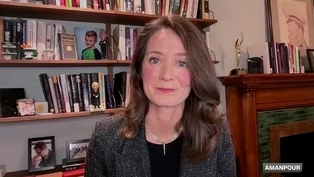
Are We in a Constitutional Crisis? The Supreme Court Year in Review
Video has Closed Captions
Clip: 12/12/2025 | 18m 2s | Law professor Kate Shaw looks at some of the year's most significant SCOTUS cases. (18m 2s)
Providing Support for PBS.org
Learn Moreabout PBS online sponsorship
- News and Public Affairs

Top journalists deliver compelling original analysis of the hour's headlines.

- News and Public Affairs

FRONTLINE is investigative journalism that questions, explains and changes our world.









Support for PBS provided by: