
Nebraska Wildfire, Mexico Cattle Imports and Grain Rallies Lose Steam
Season 51 Episode 5150 | 26m 45sVideo has Closed Captions
Mexico cattle imports, lettuce sourcing, Nebraska wildfire and grain markets with Dan Hueber.
On this edition of Market to Market ... USDA prepares to resume cattle imports from Mexico while monitoring New World screwworm risks. Consumers seek new lettuce sources during a Cyclospora outbreak. Nebraska ranchers recount surviving a record wildfire. Dan Hueber explains why wheat, corn and soybean rallies faded and what changing cattle supplies could mean for livestock markets.
Problems playing video? | Closed Captioning Feedback
Problems playing video? | Closed Captioning Feedback
Market to Market is a local public television program presented by Iowa PBS
Nebraska Wildfire, Mexico Cattle Imports and Grain Rallies Lose Steam
Season 51 Episode 5150 | 26m 45sVideo has Closed Captions
On this edition of Market to Market ... USDA prepares to resume cattle imports from Mexico while monitoring New World screwworm risks. Consumers seek new lettuce sources during a Cyclospora outbreak. Nebraska ranchers recount surviving a record wildfire. Dan Hueber explains why wheat, corn and soybean rallies faded and what changing cattle supplies could mean for livestock markets.
Problems playing video? | Closed Captioning Feedback
Where to Watch Market to Market
Market to Market is available to stream on pbs.org and the PBS app.
Providing Support for PBS.org
Learn Moreabout PBS online sponsorship>> Coming up on Market to Market.
The fight against the New World.
Screwworm hits another milestone.
Consumers across the country seek produce from new sources, surviving a record smashing fire on the Great Plains.
And commodity market analysis with Dan Huber.
Next.
>> [MUSIC] >> I wouldn't be here without my customers.
>> Yeah.
I'd like to thank the customers there.
They're very dear to our hearts.
>> It's about the people that you're working with and the relationships that you have.
>> Thank you, thank you, thank you.
>> Thank you from the bottom of my heart.
>> [MUSIC] >> Tomorrow for over 100 years, we've worked to help our customers be ready for tomorrow >> [MUSIC] >> Trust in tomorrow.
Information is available from a Grinnell Mutual agent today.
>> Support for Market to Market has been provided by a bequest from Philip Leeds of Alta, Iowa, in recognition of public television's commitment to agricultural programing.
>> Market to market is made possible in part by a grant from the Corporation for Public Broadcasting.
>> This is the Friday, July 31st edition of Market to Market, the weekly Journal of Rural America.
>> Hello, I'm Paul Yeager.
The war with Iran entered its fifth month this week, sending energy prices higher.
The cease fire that lasted from early April to early July did help cool off inflation, which led to an increase in consumer spending.
Durable goods items lasting more than three years were up last month by 3/10 of a percent, with computer and electronic purchases leading the way.
The Federal Reserve's Board of Governors voted to keep interest rates the same, with newly appointed Fed Chair Kevin Warsh leading the majority.
Three governors dissented and sought an increase to tackle persistent inflation.
The decision took into account the Board of Governors chosen inflation index.
That's the PCE.
Now, despite the month over month reading dropping a 10th of a percent and the annual rate falling almost half a point to 3.7%, the Fed's benchmark of 2% year over year is still a distance away, according to the centers for Disease Control and Prevention.
Cyclospora infections linked to iceberg lettuce from central Mexico have hit nearly 2000 cases.
Officials with Taco Bell, a major user of shredded iceberg, say in store sales are down 2% due to customer concerns over the outbreak in the West, some growers and grocers are tapping into hydroponics to keep up with increasing demand for lettuce from alternative sources.
Tammy Scardino, our Mountain West bureau chief, has the story.
>> At Greenwave Hydroponics in Fruitland, Idaho, this sea of leafy greens receives its nutrients from water.
Owner Amos Wingerd grows lettuce and herbs to fill 4000 packages a week.
His produce is sold in a handful of grocery stores across the region.
>> Every day I get calls and people wonder if lettuce is safe to eat.
And absolutely, it's grown in this controlled environment.
We don't spray any pesticides or anything, and a lot of lettuce, it grows hydroponically in the in the water.
It never gets any dirt.
It never gets contaminants.
So it's very safe to eat.
A lot of times we're the only local option in grocery stores.
>> That's not the case at one of their customers storefronts at the Boise Co-op.
All of their local foods are sourced from Idaho within 150 miles.
>> The further away that your food is, and the more corporations and different kinds of things that are layered in there.
By the time your food makes it from production to your table, people just like less meddling.
They want to know that it wasn't sprayed with harmful pesticides and all kinds of ingredients that aren't good for their health and good for their bodies.
>> Wingerd also operates his own pop up market.
>> People are definitely on the lookout for more local, more safe.
>> For Market to Market.
I'm Tammy Scardino.
>> 14 months ago, a new World Screwworm fly was discovered within 25 miles of the U.S.
Border with Mexico.
USDA closed the southern border in an abundance of caution.
Cattle prices soared.
The first U.S.
Cases, now 43 in number, were just detected this June in Texas and New Mexico.
The small number has yet to deter USDA Secretary Brooke Rollins from her.
Livestock imports.
The move is contingent on Mexico adhering to a joint action plan and all animals passing inspection.
USDA officials say the closest case of NWS to the first port to be opened is 325 miles away.
Laurel Bower has the details.
>> U.S.
Secretary of Agriculture Brooke Rollins visited the livestock inspection facilities at Douglas, Arizona, this week.
She highlighted the department's preparations ahead of the planned reopening of the port to livestock trade on August 24th.
In addition, Secretary Rollins declared USDA's commitment to invest $25 million toward the opening of a new sterile fly dispersal facility in Arizona.
In its long term response to New World Screwworm under USDA's phased reopening plan, each animal will receive multiple veterinary inspections before entering the country.
Industry groups, including the Meat Institute and National Cattlemen's Beef Association, support the move.
According to USDA, the timeline remains contingent upon continued progress by Mexico and ongoing risk assessments for Market to Market.
I'm Laurel Bower.
>> In March of this year, Nebraska was struck by wildfires that burned hundreds of thousands of acres, killed hundreds of cattle, and took one life.
Producer Colleen Bradford Krantz spoke with a few of the survivors and found stories of bravery and sacrifice in the face of danger.
Her report is our cover story.
>> Craig Shafer was in an Oshkosh, Nebraska, hardware store when he first sensed that.
March 12th, 2026, might become a day he'd remember.
>> I saw a fire truck go by and somebody said, I heard there was a fire started up by Angora, north of Bridgeport.
And I said, oh my, that's not good.
We had a fire come through that started in very close to the same spot in 1989.
I knew that it could roll across us and a lot of other ground.
I mean, the grass is cured out, it's all brown and nothing but fuel.
>> The Sandhills was a tinderbox after months of drought.
>> Attention, Bridgeport Fire Department.
A grass fire at the ranch.
>> The fire started as crews tried to reerect two utility poles toppled by high winds.
But the wires accidentally crossed and sparked.
>> Before.
21 Bridgeport.
>> This new federal satellite wildfire tool shows how it traveled 70 miles in the first 12.
>> Hours.
>> As general manager of Rush Creek Ranch, 166,000 acres in western Nebraska, Schaefer immediately thought about the ranch's 8500 cows, most a few weeks from calving.
Schaefer warned the ranch's employees, whose bases might be in the fire's path.
One worker had a close call.
>> I called him and I said, are you seeing smoke yet?
And he said, it's so thick I can't see the end of the hood on the pickup.
And I said, where are you?
And he said, well, I'm trying to move some cows.
I said, don't be a hero.
Please leave.
I don't like to think about it.
I'm just glad everybody was safe.
>> Bridgeport where do I go to get water?
>> The Morrill fire would not be fully contained for 12 days, ultimately burning 643,000 acres in the Nebraska Panhandle, an area almost equal to the size of Rhode Island and the largest recorded single wildfire in the state's history.
One woman was killed, as were more than 200 cattle and other livestock, and numerous buildings were destroyed.
As of July 2026, wildfires in Nebraska have burned a record 935,000 acres.
Nebraska's previous statewide annual record was just over 348,000 acres in 2012.
>> Really over the last ten now to 15 years, we've seen a major increase in the total amount of area burned by wildfires in the Great Plains.
What we used to say is like, you know, when I was down at Texas and Oklahoma, this is going to be the next wildfire frontier in the United States.
And then that started to play out in 2006, 2008, 2011.
Then we said it was Kansas then, and now it's Nebraska.
>> Drought and high winds have combined with the spread of so-called volatile fuels, particularly eastern red cedar trees, to worsen the problem.
>> You hear a sense of urgency not just here, but South Dakota.
You know, now North Dakota starting to talk about Cedar just starting to emerge and expand.
>> Tidwell's team has created digital maps showing locations of historical fires to remind ranchers that even the delicate sandhills recover over time But it's hard to think that far ahead, when things looked as bleak as they did for Dusty Wilson on March 12th.
Wilson, who ranches with his father, Delwin, and his wife Brandy, near Arthur, was getting texts that afternoon as friends to the West, tried to fight the fire.
>> Those embers was was going out probably 100 yards out in front of it all the time.
By the time we heard, it was 15 miles away to when we saw it here, it was just a matter of minutes.
>> Wilson's wife had taken the kids to safety, but he stayed behind with his 85 year old father to open gates for the cattle and horses.
>> That's when the fire crested the hill right behind his house.
>> 25 In Route Part two.
>> We had already had the evacuation notice prior to that, and then we finally heeded that call.
At that time.
And tried to leave the valley here and actually weren't able to, because when we tried to go up the hill here, the fire jumped the road in front of us.
>> Going to get.
>> They turned off the road trying to outrun it.
>> The whole hill line in the other end of the valley was engulfed in flames.
The winds were 75 mile an hour coming across it, you know, from northwest to southeast.
And you couldn't see.
So you didn't quite know where the flames were chasing.
>> You.
>> When the fire wrapped around here in my yard, we thought this place was gone.
And, you know, part of me wanted to stay and save this house.
But having my father with me, I knew I had to save him too.
>> They made for a windmill, knowing cattle traffic keeps the ground bare.
>> Nine.
Six.
Four.
Two.
>> You know, adrenaline kicks in as you're trying to save your place and your cattle and whatnot.
There was a brief moment there as we were trying to kind of pick our way to safety.
He and I had a little time, a second or two, to maybe talk about a few things.
>> They had no cell service, but they hung their hopes on that 40 foot circle of sand.
After enduring the smoke and embers that made the world around them dark, the fire finally passed.
About 90% of lazy five ranches, 14,000 acres had burned, but the cattle and horses all survived.
One group of about 300 cows found its way to one of the few small areas that the fire skipped.
The heartbreak came when the two men learned their 86 year old neighbor and friend, Rose white, had not survived.
>> Almost to the Broadwater.
>> In early July, the federal government declared Arthur Garden Grant, Lincoln and Morrill counties.
Disaster areas, citing $9.6 million in damage.
The Panhandle has slowly begun to recover, but much of the area remains in exceptional or extreme drought.
Many ranchers have moved cattle elsewhere as the range recovers.
>> Many of the ranchers around here, from guys my age to to all the older guys, had never seen anything quite like that before.
>> For Mark to market, I'm Colleen Bradford Krantz.
>> Next, the Market to Market report.
>> Wet weather.
Ukrainian attacks on Russian infrastructure and Chinese buying all served as market movers for the trading week ending July 31st.
The nearby wheat contract lost $0.39 and the September corn contract fell $0.24.
Even with China making room for grain, the bears were in control of the soy complex.
The November soybean contract dropped by $0.66, and the September meal decreased $15.90 per ton.
December cotton added $1.81 per hundredweight.
August Class three milk futures fell $0.32.
The livestock complex was mixed.
October cattle put on four.
75.
September feeders rose two.
33 in the October Lean hog contract sold off for 18.
In the currency markets, the U.S.
Dollar index cut 152 ticks.
September.
Crude oil sold off for $0.10 per barrel Comex gold lost 1620 per ounce, and the Goldman Sachs Commodity Index fell more than 25 points to settle at 600 8785.
Here now to lend us his insight on these and other trends is regular market analyst Dan Hueber.
Hello, sir.
>> Hello.
How are you?
>> This wheat market was going to be pretty easy to talk about is what the major market mover was.
It was Russia.
Ukraine until it wasn't.
Correct.
Is it a perspective change or did something systematically change between those two in the war?
>> Well, I don't know if anything could change permanently by any stretch of the imagination.
Granted, the rally, which really was a one day kind of a one day event, was when it was, you know, news that the Ukraine drone strikes had hit one of the major ports in Russia.
And I remember the exact tonnage that ran through that port.
But, you know, those are the kind of catalysts that usually can give you a at least a multi-day rally.
But it barely made a day.
You know, so I think that it kind of shows underlying in these markets.
They were overbought, just really needed some more news than that to sustain the move.
You know, we've really thrown a fair amount of good news or I should say positive news at the wheat market recently.
We just cannot seem to sustain those rallies, which would just say, well, we're tired.
You know, we've got these things factored in there.
And unless something new develops, that's going to extend more than a a one bombing event, you know, it's going to be pretty difficult to hold things, hold things together.
>> So and moving forward, we are still stuck with a low poor crop in some parts of the United States.
Certainly a couple of other regions of the country, of the world having that same issue.
Those fundamentals haven't changed.
So are we just kind of going to bob and weave here for just a little bit?
>> I think so.
You know, interestingly enough, when you look at wheat and corn, let's go back to the old voice of the tomb or prophecy, however you want to put it.
It said you by July wheat, July 1st, you by December corn.
December 20th.
Well, you know, or probably June 20th.
Well, those would have been pretty effective up until this week, you know.
So we were looking at really what we're we're mostly seasonal type of trades, but I think we just kind of ran out of the fuel to keep the keep the bull excited about it.
And, you know, not that there aren't some problems, particularly in the western side of the Corn Belt, but boy, when you drive across Illinois and Indiana, you'd be hard pressed to want to be bullish on anything at this point in time.
So.
>> Well, let's talk old crop corn.
We'll get to that bullish side of of the crop situation with with new crop corn.
This old crop a is there any left.
B do these moves have any more life up.
>> You know, up until today I was thinking we probably had enough stimulus out there to maybe maybe take one more move back up and maybe challenge some of the highs we saw back in the spring.
At this point in time, I it's pretty questionable.
You know, I wouldn't give it even maybe a 5050 odd, maybe a 6040 chance or a 4060 chance.
I should say that we could rebound one more time here.
But, you know, not that we're going to come apart.
You know, we don't really have a what you would call a burdensome situation in the corn supply situation.
But these are supply markets.
And I think that's one thing you always have to keep in perspective.
We're on the supply side of the cycle, which means, you know, rallies are going to be relatively short lived.
You know, it's just going to be hard to sustain them if you don't have a new driving demand force that's going to carry you to, to different levels.
And I don't see where that's out there at this point in time.
>> Monday, USDA cut four points from the crop condition.
Tuesday.
Wednesday, the rain forecast started to reemerge, and that weather rally was gone.
>> Kind of fizzled out.
Correct?
Correct.
>> Is that where we're at right now?
Is living day to day on a weather forecast?
>> Well, you know, difficult at this late in the year to really even say you're going to get a weather situation in the corn market.
You know, I think a lot of people assume once you move, move past July, we've kind of played that card for corn, not that you couldn't see that in soybeans and soybeans.
Got excited again.
Sure you could.
You could curtail some corn along with it.
But I think as far as weather related rallies, you know, barring an early frost, you know, granted, now we're talking another 30 or 60 days out.
It's going to be difficult to make that happen with weather.
>> You mentioned a couple of bounces higher.
We retraced a little bit of some of our gains towards the end of the week in December.
Corn.
Great.
But is that are those technical singles signals done?
I mean, in us moving back forward higher I should say not forward.
>> But not done yet.
You know.
And again, most of the retracements at this point are 50, 60% of the the June-July rally we witness here.
That's not enough to say, boy, the we've had it, you know, we just can't come back.
So yes, we still could come back.
But like I say, if it's not a new element, if it's not a new driving force that we're not expecting at this point in time, there are probably going to be just retracements within the range that we've already been.
So it's again, we're probably not looking at a market that's going to fall apart.
It's going to crumble down to where we were, you know, let's say 30 days ago or 45 days ago.
But here again, to sustain rallies for anything more than a technical bounces, it's going to be a real challenge.
>> I was just looking for some positivity on the technical side, seeing if we didn't have it on the fundamental side, Let's Talk fundamentals with whether if we could Joel in Minnesota and Dan, you can answer this one with corn or beans, whichever you prefer.
Rain did fall in some areas needing it.
Is that why the market responded lower?
>> You know, I think a combination of that and we can't forget this was also a month end.
You know, we've we've had a pretty substantial rally corn, soybeans, wheat, all three during the early part of July here.
And I think there was some profit taking that was just happening.
You know, the large money, the managed money definitely has swung over to the long side of most of the markets.
I think Chicago was the only exception.
And, you know, they were probably at the point we've we've shown a nice return over the last 30 days.
Let's take some of that off the table.
>> Well, the trade flows you wrote about earlier this week, and I think the soybean side of that discussion was fueled a little bit by China putting up grain for bid signaling.
Maybe they were going to come buy in U.S.
Beans.
Are they buying old crop or new crop.
>> Primarily, primarily new crop, but they have bought some old crop.
Don't take me wrong.
But I mean, when you look at where they're buying beans right now, they're buying into that slot, which they usually do when Brazil, South America is out of beans, they need to cover themselves until January, February period where Brazil product is going to be available again.
So you know this I wouldn't look at this as anything more than a normal seasonal pattern for them buying, locking ahead for the days ahead.
>> Okay.
So if that's not a bear signal, what is for beans?
>> Well, again, you know, we're looking at comfortable supplies of soybeans.
You know, we're not looking at an unusual amount of of demand coming in.
So, you know, here again, it was a, it was a great run.
You know, you did you pushed beans up to levels we hadn't seen in about two years.
You know, retraced some great made some great technical retracements in there.
But like I say, I think you just you just ran out of gas, you know, there was just not enough to, to keep that bull engine moving.
>> And it looked like many people took advantage of a little bit of that.
>> Oh, certainly sold into it.
Yes.
Yes, exactly.
>> And then did the funds change positions to here.
>> I haven't seen the numbers for this week yet, but you know, undoubtedly the manage money crowd liquidated.
Not that they're short in the market at this point, but I'm sure they did some pretty good liquidation here into the month end.
>> Cattle market had a little bit of a stall in mid July.
This week.
Changed the tune.
Why what was leading that band.
>> You know I and again, I wouldn't say you know, I guess we hate to rely everything on technicals, but I think we had so deeply oversold that market that it was ready for a rebound.
And you know it's nice to see the October's bounce the way they did.
I would like to think they could get back into that two or 30 to 233 range something in that neck of the woods.
But here again there's there's enough shift between again opening the border now with more more cattle from Mexico.
We know we've been trying to bring in more Brazilian beef.
You know, I think the number one agenda of the government is to, you know, get food prices moderate, moderating, not that you can force them down, but try to get them moderating between now and Election Day.
So that's going to be a tough one.
>> But we knew both of those stories were hanging out there.
Right.
That's not a surprise.
Yeah.
Okay.
Let's talk feeders if we could, because on that retention side always seems to be the hot topic for the last two, three years.
Any signals yet of holding back?, >> not really.
Not really.
You know, again, I mean, I think that that market is going to, of course, ebb and flow partially with what's going on in the grain.
So I think, you know, moving the when we did see the rally of the grains, you had people possibly hesitating a little bit.
But, you know, as we continue to push further and further into this cycle, I think it's the I mean, the risk for the for those people purchasing feeders just continues to elevate and elevate.
I think I think a lot of them recognize that, you know, we're probably operating on borrowed time here.
So it's, you know, let's, let's not stick our necks too far out.
>> Hogs had a little,.
>> Little problem.
>> Well, they had, they started, started.
>> This rally, right?
>> Why did they finish?
>> Not right.
Right.
You know, and really, you know, the move we saw, I mean, had all the ear markings that we have a seasonal low in there, that we, you know, we're ready to turn the corner.
you know, I shouldn't even say seasonal low.
We just had a reaction low in there, you know, again, here, here, here's where you are fighting the seasonals.
We tend to see hog prices continue to drift lower into the fall at this point in time.
So, you know, it's been a little bit of a backwards year already.
So, you know, maybe we'll see if they can recover come Monday.
But that damage today looked a little bit more serious.
>> So but are you is it panic mode yet.
>> Well, if you haven't panicked already, it's probably not time to do it now.
So I mean, it's again, like I say, I think we push those October's far down farther than I expected him to.
But you know, this first rebound looked pretty solid.
Again, if we can stabilize here at the first of the week again, maybe transitioning into a new month will bring a little better attitudes there.
But we can't afford to lose much more ground than we have already.
>> I forgot one cotton.
We rallied $1.81 this week.
What is driving this?
The return of cotton.
>> Well, you know, of course cotton had like the rest of the markets, had a little bounce and then retraced back, but it didn't get damaged as the other row crops.
So here again, I think there's when you look at the ratings in the cotton crop, it's probably the the worst looking crop we have out there in the country.
So it's here again, the, the move today, I think, told us that, you know, we've got a bottom in there and not that you're going to go wild on the upside, but at least we can start recovering some of the ground we lost here over the last couple of months.
>> Well we haven't lost any time with you but we are out of it.
>> Oh there.
>> We go.
Good to see you Dan.
>> Thank you, thank you.
>> Dan Hueber everyone on our Market Analysis segment because that's what you've been watching here on our program.
In a moment, Dan and I are going to continue our discussion in an online only segment.
Find it by searching Market Plus with Dan Hueber wherever you get your podcasts, you can also go to our website at Markettomarket.org to listen.
We go over a lot of information during the market analysis and plus, and if you want to go look at everything again, subscribe to our YouTube channel.
Be sure to click notifications so you'll know when we've posted the show, our stories and podcasts next week.
We look at a grocery store that's keeping a community from turning into a food desert.
Thank you so much for watching.
Have a great week.
>> [MUSIC] [MUSIC] >> Market to market is a production of Iowa PBS, which is solely responsible for its content >> Market to market is made possible in part by a grant from the Corporation for Public Broadcasting.
>> Support for Market to Market has been provided by a bequest from Philip Leto of Alta, Iowa in recognition of public television's commitment to agricultural programing >> [MUSIC] >> I wouldn't be here without my customers.
Yeah, I'd like to thank the customers.
They're.
They're very dear to our hearts.
>> It's about the people that you're working with and the relationships that you have.
>> Thank you, thank you, thank you, thank you from the bottom of my heart >> [MUSIC] >> Tomorrow.
>> For over 100 years, we've worked to help our customers be ready for tomorrow >> [MUSIC] >> Trust in tomorrow.
Information is available from a Grinnell Mutual agent today.
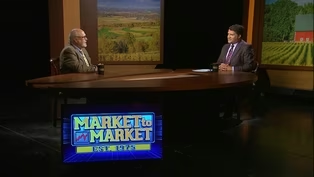 New
NewAugust’s Weather Window Closing Soon – Market Plus with Dan Hueber
Video has Closed Captions
Clip: S51 Ep5150 | 10m 57s | The weather’s influence on the market may be closing soon, according to Dan Hueber in Market Plus. (10m 57s)
Providing Support for PBS.org
Learn Moreabout PBS online sponsorship New Episode
- News and Public Affairs

Top journalists deliver compelling original analysis of the hour's headlines.
 New Episode
- News and Public Affairs

Today's top journalists discuss Washington's current political events and public affairs.

 New Episode
 New Episode
 New Episode
 New Episode
 New Episode

 New Episode
 New Episode
Support for PBS provided by:
Market to Market is a local public television program presented by Iowa PBS