
Trump pressures NATO on defense spending, loyalty, Greenland
Clip: 7/7/2026 | 7m 27sVideo has Closed Captions
At NATO summit, Trump pressures allies on loyalty, defense spending and Greenland
New U.S. strikes on Iran come against the backdrop of the NATO summit in Turkey, where leaders are hoping to strengthen Europe’s ability to defend itself. President Trump brought his long-standing criticisms of European countries, once again expressing frustration over their defense spending and refusal to support the U. S. and Israeli war in Iran. Nick Schifrin reports from Ankara.
Problems playing video? | Closed Captioning Feedback
Problems playing video? | Closed Captioning Feedback
Major corporate funding for the PBS News Hour is provided by BDO, BNSF, Consumer Cellular, American Cruise Lines, and Raymond James. Funding for the PBS NewsHour Weekend is provided by...
Trump pressures NATO on defense spending, loyalty, Greenland
Clip: 7/7/2026 | 7m 27sVideo has Closed Captions
New U.S. strikes on Iran come against the backdrop of the NATO summit in Turkey, where leaders are hoping to strengthen Europe’s ability to defend itself. President Trump brought his long-standing criticisms of European countries, once again expressing frustration over their defense spending and refusal to support the U. S. and Israeli war in Iran. Nick Schifrin reports from Ankara.
Problems playing video? | Closed Captioning Feedback
Where to Watch PBS News Hour
PBS News Hour is available to stream on pbs.org and the PBS app.
Providing Support for PBS.org
Learn Moreabout PBS online sponsorshipAMNA NAWAZ: Well, strikes in Iran come against the backdrop of the NATO summit in Turkey, where leaders are hoping to strengthen Europe's ability to defend itself and become less dependent on the U.S.
military.
President Trump brought his longstanding criticisms of European countries, once again expressing frustration over their defense spending and the refusal to support the U.S.
and Israeli war in Iran.
And in his first appearance, he even made it clear he still has eyes on the Danish territory of Greenland.
Nick Schifrin reports from Ankara.
NICK SCHIFRIN: Today, President Trump arrived in Turkey on his new Air Force One and embraced what he called his - - quote -- "special relationship."
DONALD TRUMP, President of the United States: We're going to have a good time.
I like this man a lot.
NICK SCHIFRIN: And President Trump suggested he would soon give what Turkey's strongman leader has long desired.
DONALD TRUMP: It's a great plane.
It's the best, currently the best plane by far.
NICK SCHIFRIN: That plane is the F-35, what the U.S.
calls the most lethal and most connected fighter jet and one of the U.S.'
most sensitive military technologies, too sensitive since the first Trump term for Turkey, because Turkey uses Russian air defense missiles that the F-35 is designed to defeat.
But, today, President Trump suggested Turkey deserved the F-35, despite Israeli and some congressional opposition.
DONALD TRUMP: Turkey's been in many ways much more loyal than other countries that we think would be loyal.
RECEP TAYYIP ERDOGAN, Turkish President (through translator): Mr.
Trump always stands by his word.
I believe that, God willing, a positive decision will emerge from this leaders summit regarding the F-35.
NICK SCHIFRIN: As for the rest of NATO, President Trump arrives here not with rewards, but reprimands, and what a senior administration official described as a -- quote -- "expectation" that NATO leaders put their money where their mouths are.
DONALD TRUMP: Over the past few days, I was honored to participate in the NATO leaders meeting.
NICK SCHIFRIN: It was just a year ago at the NATO leaders summit in The Hague that President Trump praised NATO allies for pledging to spend 5 percent of their GDP on defense by 2035.
DONALD TRUMP: It was great.
And I left here differently.
I left here saying that these people really love their countries.
It's not a ripoff.
And we're here to help them protect their country.
NICK SCHIFRIN: For NATO, that was a good day.
It's been a bad year.
DONALD TRUMP: But most European nations, they're decaying.
They're decaying.
NICK SCHIFRIN: In January, President Trump challenged the sovereignty of NATO ally Denmark, vowing to seize Danish territory Greenland.
DONALD TRUMP: It's the United States alone that can protect this giant mass of land, this giant piece of ice, develop it and improve it.
NICK SCHIFRIN: A threat he reiterated today.
DONALD TRUMP: That should be controlled by the United States, not by Denmark.
And when they wouldn't go along with it, and with all the money we spent to help them with Russia, and we don't have to spend any money.
We could remove all of our soldiers out of Europe.
NICK SCHIFRIN: He's also denigrated European sacrifices since 9/11, even though, relative to their population, some European countries lost more men than the U.S.
DONALD TRUMP: They will say they sent some troops to Afghanistan or this and that.
And they did.
They stayed a little back, a little off the front lines.
This is not Winston Churchill that we're dealing with.
NICK SCHIFRIN: And since then, he's questioned NATO leaders and the alliance's very purpose after European countries declined U.S.
requests to use bases to attack Iran.
DONALD TRUMP: Why are we spending hundreds of billions of dollars and they're not there for us?
We have always been there for them.
MARK RUTTE, NATO Secretary-General: We have a lot to show today.
NICK SCHIFRIN: And so, today, NATO Secretary-General Mark Rutte portrayed the alliance as stepping up, announcing the purchasing of new NATO capabilities built in part by European countries to begin to replace what until today has been mostly American-made, European planes to move heavy equipment, European long-range missiles, and a European-built satellite network.
MARK RUTTE: These are capabilities that are really made in NATO, not by one nation, but several, working together in close cooperation.
And that's how we make our alliance more powerful.
NICK SCHIFRIN: Europe is spending more money on defense, but some of these technologies will take Europe years before they're fielded.
Until then, NATO remains dependent on American troops and technology.
And the U.S.
says it will reduce U.S.
troops and bases in Europe.
So Europe needs the U.S.
to do that slowly and collaboratively.
PETE HEGSETH, U.S.
Defense Secretary: Our allies are not children.
NICK SCHIFRIN: But U.S.
officials now suggest they might decide on the future of U.S.
troops in Europe based not on the threat or the costs, but on whether countries have been naughty or nice.
PETE HEGSETH: Model allies that step up like Israel, South Korea, Poland, increasingly Germany, the Baltics and others will receive our special favor.
Allies that do not, allies that still fail to do their part for collective defense, will face consequences.
NICK SCHIFRIN: Recently, Hegseth has pledged to work with allies and Congress.
And when I asked a senior NATO official here in Ankara today whether the U.S.
could reduce its security presence too quickly and leave Europe vulnerable, the official replied the transition will be manageable if Europe steps up -- Amna.
AMNA NAWAZ: Nick, as you reported earlier, the president suggested that he could send F-35s to Turkey.
That would reverse a ban that he instituted in his first term.
So what would go into that decision?
NICK SCHIFRIN: Remember, Amna, why President Trump signed that law during his first term and imposed sanctions on Turkey.
And that was because Turkey imported a Russian air defense system, the S-400.
And the concern was that if the S-400 locked on to the F-35, Russia could then not only learn how to shoot down the F-35, but steal some of the jet's most sensitive technology.
And the law is very specific.
If the U.S.
is going to start selling Turkey the F-35 again, the secretaries of state and defense have to pledge that Turkey has gotten rid of the F-35 and pledged never to buy Russian air defense again.
Now, President Trump was asked about that today.
He said the sanctions would come off, and -- quote -- "I have no concerns about anything having to do with Turkey," although he did not say a decision had been made yet.
But there will certainly be opposition to this, Amna.
Today, Israeli Prime Minister Benjamin Netanyahu reiterated, in his words, that this would -- quote -- "destroy the power balance" in the Middle East and lead to a more aggressive Turkey.
And there's bipartisan concerns in Congress against Turkey, against Erdogan because of support for Hamas, threats to Greece, and even crackdown on the opposition that has continued while we're at this summit.
AMNA NAWAZ: Meanwhile, we know another focus of the conference today was the war in Ukraine.
Tell us about the message that Ukrainian President Volodymyr Zelenskyy brought to the summit.
NICK SCHIFRIN: Zelenskyy, of course, is asking Ukraine to be a member of NATO, which is off the table.
But the main message here is about air defense.
And that's because, earlier this week, Russia launched another salvo of drones and missiles, and every Russian ballistic missile got through, which shows Ukraine has zero American Patriot air defense missiles left.
So, today, Zelenskyy said it needed more air defense, and he urged Europe not to be so dependent on American air defense, create its own capabilities.
That's a message that resonates with European leaders, Amna.
But, tomorrow, the focus will be on Zelenskyy meeting President Trump here on the sidelines of the summit.
AMNA NAWAZ: All right, that's Nick Schifrin reporting from the NATO summit in Ankara, Turkey.
Nick, thank you.
NICK SCHIFRIN: Thank you.
 New
NewEEOC abandons tool for combating workplace discrimination
Video has Closed Captions
Trump's EEOC abandons key tool for combating workplace discrimination (7m 15s)
 New
NewHow hospitals are using the arts to help patients recover
Video has Closed Captions
How hospitals are using the arts to help patients recover (6m 16s)
 New
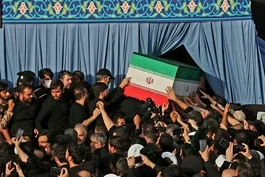
NewIn Iran, mourners honor Khamenei while critics remain quiet
Video has Closed Captions
Inside Iran as mourners honor Khamenei while critics remain quiet (8m 24s)
 New
NewMore Democrats call for Platner to drop Maine Senate bid
Video has Closed Captions
More Democrats call for Platner to drop Maine Senate bid after sexual assault accusation (5m 52s)
 New
NewNew student loan rules reshape funding for graduate programs
Video has Closed Captions
New student loan rules could limit funding for some graduate programs (6m 24s)
 New
NewNews Wrap: Attempt to collect election worker info rejected
Video has Closed Captions
News Wrap: Judge rejects Trump's attempt to collect Georgia election worker info (6m 15s)
 New
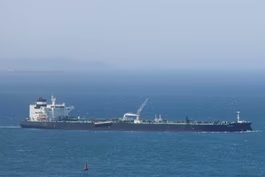
NewU.S. strikes Iran after tanker attacks in Strait of Hormuz
Video has Closed Captions
U.S. launches new strikes on Iran after attacks on tankers in Strait of Hormuz (4m 43s)
Providing Support for PBS.org
Learn Moreabout PBS online sponsorship
- News and Public Affairs

Today's top journalists discuss Washington's current political events and public affairs.

- News and Public Affairs

FRONTLINE is investigative journalism that questions, explains and changes our world.
 New Episode
 New Episode
 New Episode
 New Episode
 New Episode

 New Episode
 New Episode
 New Episode
Support for PBS provided by:
Major corporate funding for the PBS News Hour is provided by BDO, BNSF, Consumer Cellular, American Cruise Lines, and Raymond James. Funding for the PBS NewsHour Weekend is provided by...